Frequently Asked Questions
The most-asked questions about animal anatomy.
What exactly is animal anatomy?
Animal anatomy is the branch of biology dedicated to mapping the physical structure of animals—their bones, muscles, organs, and tissues—and how those parts fit together into a functioning whole. It spans everything from a fruit fly's compound eye to a blue whale's massive circulatory system.
Who are the foundational figures in the field?
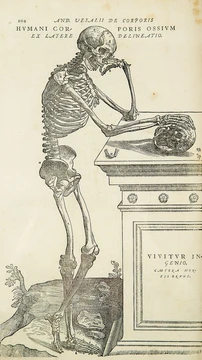
Ancient Greek thinkers like Aristotle and Galen laid early groundwork, but Andreas Vesalius is widely credited with launching modern anatomical study after his 1543 treatise corrected centuries of inherited errors. In comparative anatomy, Thomas Henry Huxley's 1860s work linking vertebrate limb structures across species reshaped evolutionary thinking.
Where should a beginner start learning?
Most learners begin with the skeletal and muscular systems because they provide a visible, touchable framework for understanding everything else. From there, working through the circulatory, nervous, and organ systems in sequence builds a coherent mental model.
What are the major body systems every student should know?
The standard set includes the skeletal, muscular, nervous, circulatory, respiratory, digestive, endocrine, urinary, reproductive, and integumentary systems. Each has a distinct job, yet they all depend on one another for survival.
What's the difference between anatomy and physiology?
Anatomy asks 'what is it and where is it?' while physiology asks 'what does it do and how does it work?' The two are inseparable in practice; a muscle's shape directly determines how it contracts.
What is a landmark moment in the history of the field?
Vesalius's 1543 publication, De Humani Corporis Fabrica, is often called the turning point because it replaced Galenic dogma with direct observation from actual dissection. In comparative anatomy, Huxley's demonstration that a bat's wing, a whale's flipper, and a human arm share the same underlying bone pattern became a cornerstone of evolutionary evidence.
What are common misconceptions about animal anatomy?
A frequent one is the idea that the human heart sits entirely on the left side of the chest, when in reality it is roughly central with only a slight leftward tilt. Another is the belief that all mammals have the same number of ribs; in fact, the count varies noticeably between species.
How do anatomists compare structures across different species?
They rely on two key concepts: homologous structures (shared ancestry, like a bat wing and a human arm) and analogous structures (similar function but different evolutionary origin, like a bird wing and an insect wing). This distinction is central to evolutionary biology and helps reconstruct phylogenetic relationships.
What are the best go-to reference resources for a newcomer?
Gray's Anatomy remains the classic human-focused text, while Netter's Atlas is widely used in medical schools for its detailed, color-rich illustrations. For comparative work, Carpenter's Comparative Anatomy and the open-access materials from the American Association for Anatomy are standard starting points.
How does animal anatomy connect to other scientific fields?
It underpins veterinary medicine, evolutionary biology, paleontology, and even robotics and prosthetics design. Understanding how a cheetah's spine flexes or how an octopus distributes neural tissue across its arms can inspire engineering solutions that purely mechanical thinking would miss.